

Order a Rp100,000 plate in Canggu and you will not pay Rp100,000. Two extra lines appear at the bottom of the bill. One is a real tax with a rate you can look up, the other is a... service charge? And outside a hotel, no law in Indonesia says the staff ever have to see it. So I went looking for where the difference goes.
Start with the fact that people are asking. Type “how to read menu prices” into Google and it will offer to finish the sentence for you with “in bali”. That is a real autocomplete suggestion, which means it is a phrase enough people type that the machine has learned to expect it. Nobody is asking how to read menu prices in Lisbon.
They have been asking for a while and nobody has answered properly. On the Bali board at Tripadvisor, a diner once posted about a Canggu restaurant charging what the bill called a 12.5% tax, and wrote: “I don’t want to support businesses that ‘invent’ a fake tax, if that money isn’t really going wherever Indonesian taxes are supposed to go.” The replies agreed 12.5% was a strange number. One suggested the venue had hidden a bigger service charge inside a line labelled tax. Nobody could say for certain. That thread is from 2019 and it closed without a conclusion, which is roughly the state of the English-language literature on the subject.
What is the 10% tax on a Bali restaurant bill? PBJT, the local restaurant tax, and it is not VAT
The line your bill calls tax, or government tax, or PB1, is a regional tax. It used to be called pajak restoran. Since Undang-Undang Nomor 1 Tahun 2022, the law on financial relations between central and regional government, it has been folded into a category called Pajak Barang dan Jasa Tertentu, PBJT, and the relevant slice is PBJT atas makanan dan/atau minuman. Everyone in the industry still says PB1. The receipts still say PB1. Legally it is a dead name.
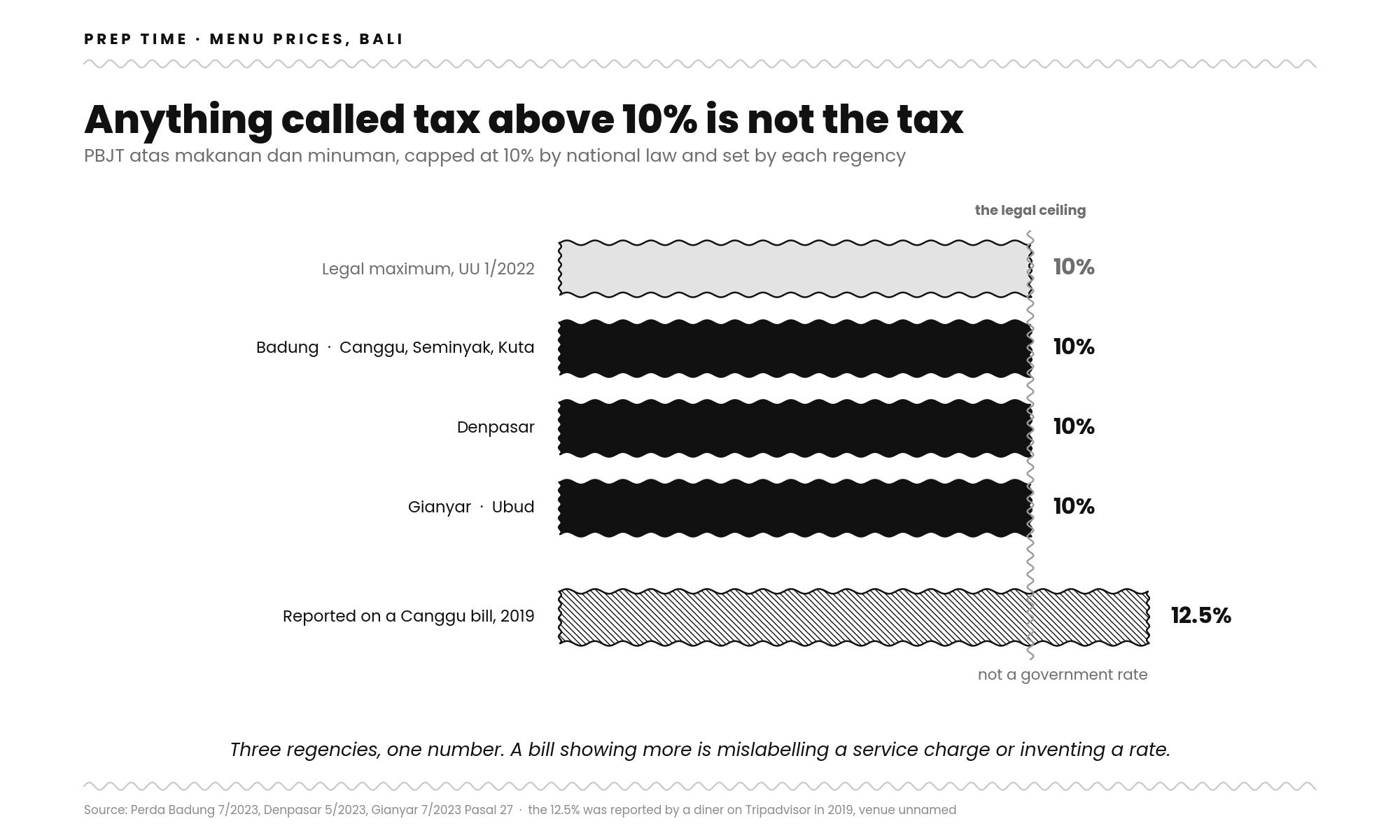
The law does not set the rate. It sets a ceiling of 10% and lets each regency or city fix its own by local regulation. For the parts of Bali most people eat in, the answer is the same three times. Badung, which covers Canggu, Seminyak, Kuta and Uluwatu, sets it at 10% under Perda Kabupaten Badung Nomor 7 Tahun 2023. Denpasar sets it at 10% under Perda Kota Denpasar Nomor 5 Tahun 2023. Gianyar, which covers Ubud, writes it into Perda Nomor 7 Tahun 2023 in a single line at Pasal 27: “Tarif PBJT ditetapkan sebesar 10% (sepuluh persen).”
One caveat on that, and I would rather give it to you than tidy it away. Badung passed Perda Nomor 8 Tahun 2025 amending the 2023 rules, in force since 1 January 2026, on the stated grounds that the old regulation no longer matched current conditions. The tariff table sits in an attachment I could not obtain. The rate is very probably still 10%, because 10% is the legal maximum and Badung was already at it, but I have not seen the document and I am not going to tell you I have.
What the tax is not, and this matters because half of Bali gets it wrong, is VAT. Food and drink served in a restaurant is expressly excluded from PPN, Indonesia’s national value added tax, precisely because PBJT already covers it. The Directorate General of Taxes published this plainly when the VAT rate changed and the public assumed restaurant bills would rise. The two do not stack. If someone tells you the 10% is VAT, they are guessing.
Where it goes afterwards is more interesting than people expect. Badung, Denpasar and Gianyar hand 10% of their hotel and restaurant tax to the six regencies with no tourism to speak of, Bangli, Buleleng, Jembrana, Karangasem, Klungkung and Tabanan, through a transfer called Bantuan Keuangan Khusus. The regents signed the arrangement in April 2025 and Governor I Wayan Koster framed it as making development even rather than southern. So a tenth of the tax on your Canggu brunch leaves the district. The scale is not small. Bali’s hotel and restaurant tax ran to Rp2.89 trillion between 1 January and 27 May 2026, against Rp2.62 trillion in the same window of 2025, with the restaurant portion alone rising from Rp885 billion to Rp1.039 trillion.
That is the clean half. The 10% is a real tax at a verifiable rate, it is legally borne by you and merely collected by the restaurant, and a slice of it builds a road in Karangasem.
Who actually gets the service charge in Bali? Outside a hotel, nobody can tell you
Service charge is not a tax. It is not owed to any government, it does not appear in any tax statute, and no law requires you to pay it. In January 2026, Intan Nur Rahmawati of BPKN, the national consumer protection agency, said exactly that, and added the observation that “tidak semua konsumen memahami perbedaan mendasar dari kedua komponen biaya tersebut”, not all consumers understand the basic difference between the two charges. She put the tax at 10% to 11% and the service charge at 5% to 10% or more, and asked for the rules to be reviewed.
The only regulation governing service charge in Indonesia is Peraturan Menteri Ketenagakerjaan Nomor 7 Tahun 2016. Read the full title before anything else: Uang Servis pada Usaha Hotel dan Usaha Restoran di Hotel. Service charge at hotel businesses, and at restaurants inside hotels.
Where it applies, it is detailed and it is good. Of the service charge collected, 95% goes to workers, 3% is held against breakage and loss, and 2% funds staff training. Of that 95%, half is split evenly among everyone eligible and half is weighted by seniority and performance. It is distributed monthly. Contract staff and outsourced staff are eligible, and anyone who leaves partway through a period is paid out proportionally. It is also, in its own words, optional. The regulation says employers dapat apply a service charge. May, not must.
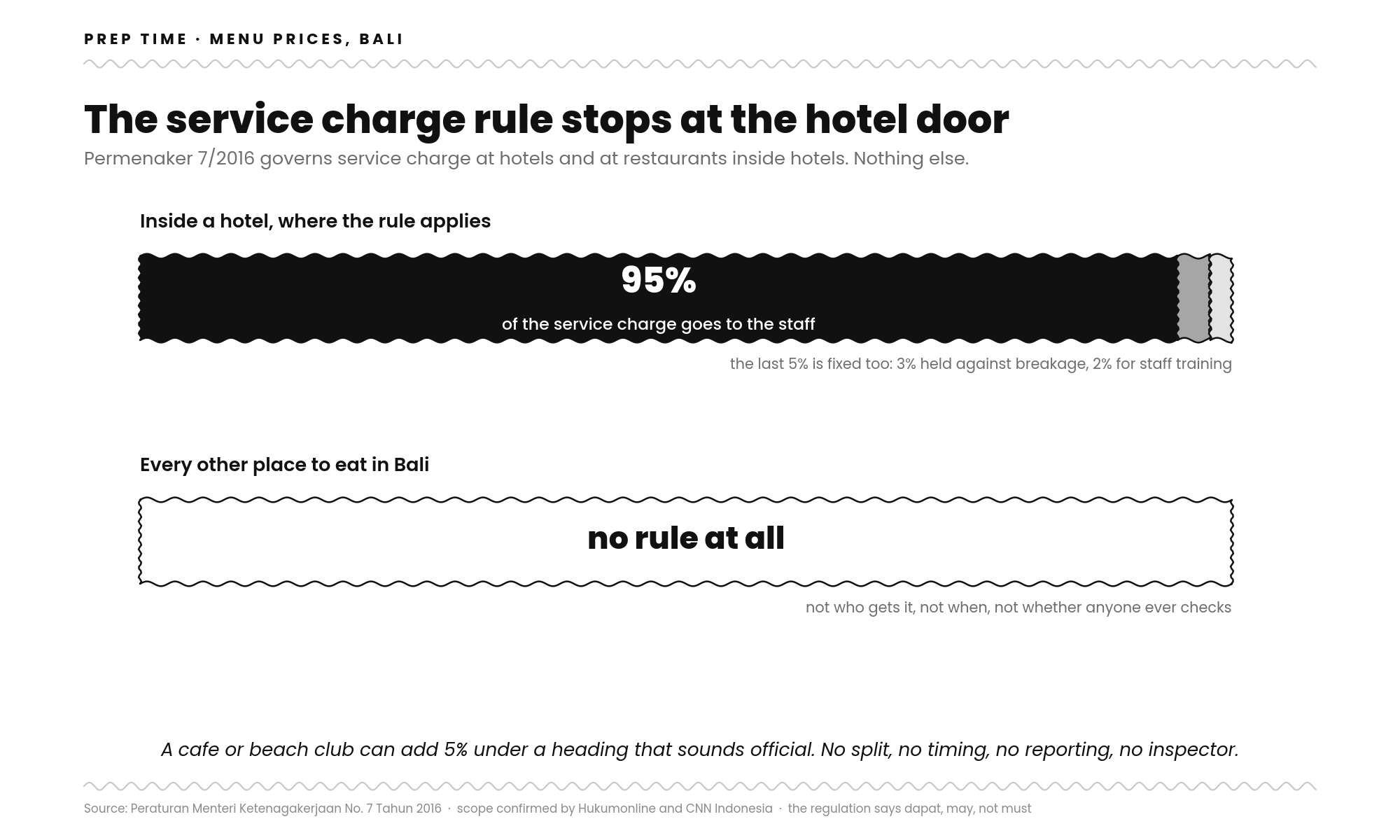
Now the part nobody has written in English. A restaurant that is not inside a hotel is outside the regulation entirely. Hukumonline states the scope limitation directly, and CNN Indonesia’s explainer repeats the same boundary and goes no further. Which means the beach club in Canggu and the cafe in Ubud can both add 5% to your bill under a heading that sounds official, and there is no rule at all about the split, no rule about timing, no reporting duty and no inspector. Whether the staff see any of it is a matter of the owner’s conscience and whatever is written in the employment contract.
One thing the law does settle. Under PP Nomor 36 Tahun 2021 on wages, service charge is pendapatan non-upah, non-wage income, which means a venue cannot pay below the minimum wage and make up the shortfall with service charge. Badung’s 2026 minimum is Rp3,791,002.57 a month, Denpasar’s is Rp3,499,878.78 and Gianyar’s is Rp3,316,798.48. Service charge sits on top of those numbers or it is being used illegally.
Do restaurant staff in Bali really receive the service charge? Ask the 159 workers at a hotel in Kuta
In late 2025, staff at Holiday Inn Resort Baruna in Tuban, Kuta, went to local media alleging their service charge had been held back. According to barometerbali, around Rp6 billion was outstanding across 159 workers for the period from March to October 2025, with staff having received only 46.25% of what they were owed.
Treat those figures as the shape of the thing rather than the measurement of it. The reported numbers do not reconcile with each other, 159 people at the per-head figure quoted comes to about Rp5.09 billion rather than Rp6 billion, and the reports do not make clear whether the Rp6 billion is the total entitlement or the unpaid balance. What is not in doubt is that a large sum was missing for eight months.
I Nyoman Graha Wicaksana, who chairs Komisi IV at the Badung legislature, said: “Kalau itu memang hak karyawan, ya wajib dibayar.” If it really is the employees’ right, it has to be paid. An unnamed worker put it closer to the ground: “Kami cuma ingin service charge kami segera dicairkan. Bahkan teman-teman yang sudah resign empat bulan juga belum terima.” We just want our service charge released. Even the friends who resigned four months ago have not received theirs. I Putu Eka Merthawan, who heads the Badung labour office, said his people were following up on the media reports even before a formal complaint arrived. Management said nothing at the time of publication, and I have not been able to establish how the case ended.
Hold that case up against the rest of the island. This was a hotel, so the 95/3/2 split was legally binding, and there was a named labour office and a named legislator with jurisdiction, and staff still needed eight months and a media campaign. Every venue in Bali that is not a hotel has none of that machinery, because the regulation stops at the hotel door.
How are tax and service charge calculated in Bali? Two different sums are in circulation
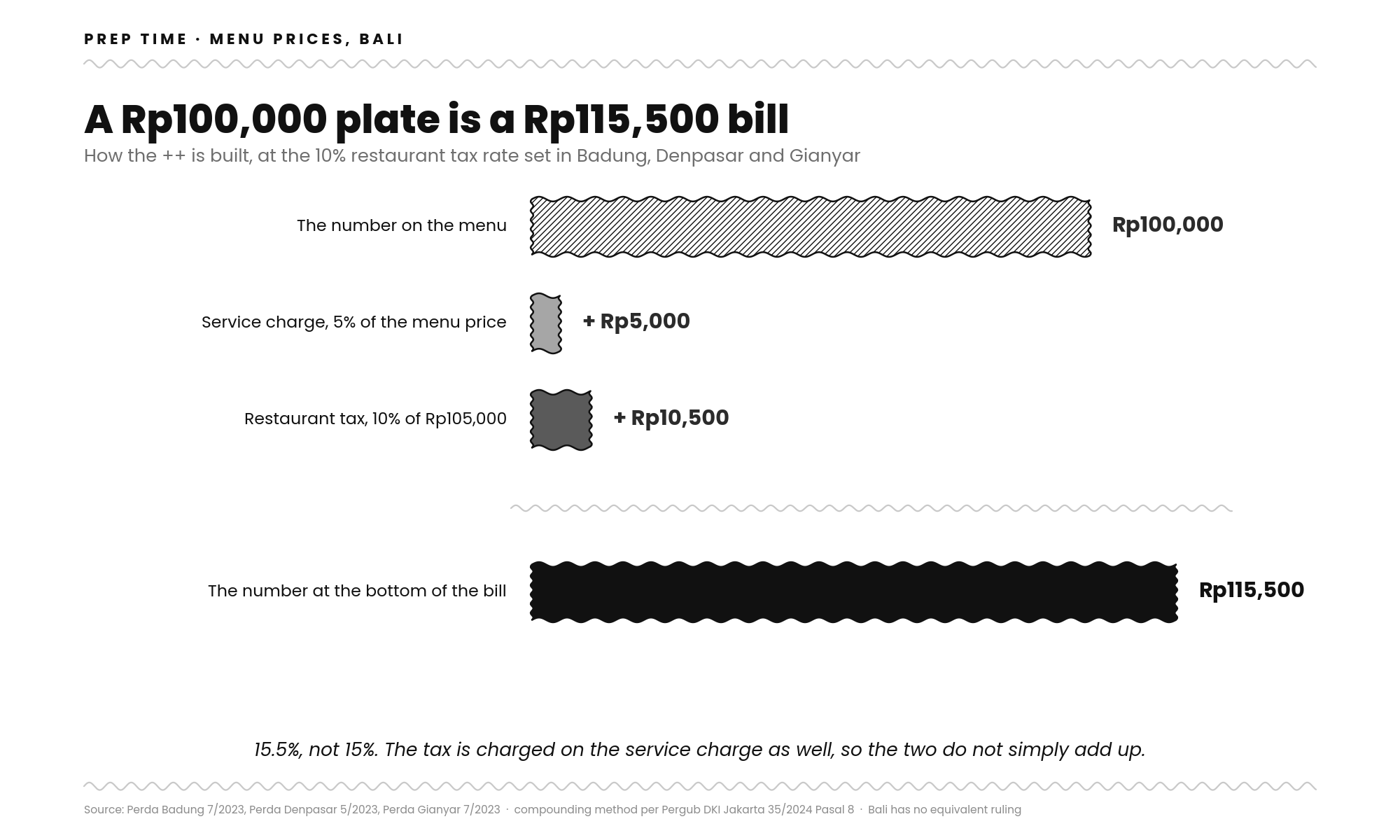
This is the small question with the annoying answer. If a venue adds 5% service and 10% tax, you might reasonably expect 15%. Whether it is 15% or 15.5% depends on whether the tax is calculated on the menu price or on the menu price plus the service charge.
Jakarta settled it. Pergub Nomor 35 Tahun 2024 says at Pasal 8 that if a business charges a service charge, that amount is already inside the PBJT base. Tax on top of service. 100 becomes 105 becomes 115.5.
Bali has not said so in the same words. The Badung, Denpasar and Gianyar regulations define the base as jumlah yang dibayarkan oleh konsumen, the amount paid by the consumer, which reads the same way, but none of them uses the phrase service charge. Meanwhile Indonesian point of sale vendors are publishing the other method, applying both percentages to the same base and arriving at a flat 15%. Two methods, one island, and the software is what actually decides it for most venues. I asked and I could not get a Bali specific ruling, so the honest answer is that a sliver of every plus plus bill on this island is being calculated two different ways.
What does nett mean on a Bali menu? The price you see is the price you pay, and nothing forces a venue to offer it
Nett means the price on the menu is the price you pay. Plus plus (++) means it is not.
There is no rule compelling either. Undang-Undang Nomor 8 Tahun 1999 on consumer protection requires businesses to give information that is correct, clear and honest, and forbids misleading statements about price, which is a general duty rather than a menu design instruction. There is a trade ministry regulation on displaying prices, Permendag 35/M-DAG/PER/7/2013, which is cited in the Indonesian academic literature as the operative rule for restaurants. I could not obtain its text. So I cannot tell you whether Indonesian law requires a displayed price to include tax already, and that gap is the difference between plus plus being merely irritating and plus plus being non-compliant.
What is left is commercial. A menu that quotes nett looks more expensive than the one next door and reads honestly at the table. A menu that quotes plus plus looks cheaper on Instagram and produces a worse moment when the bill lands. Smaller warungs often quote nett because they are below the turnover thresholds that make a business liable in the first place, though I could not confirm where those thresholds sit in Badung or Denpasar. The choice is a positioning decision dressed up as an accounting one.
There may be pressure coming. One outlet reports that YLKI, the Indonesian consumers’ foundation, filed a judicial review at the Supreme Court in April 2026 seeking to have service charge declared contrary to consumer protection law and made voluntary and disclosed upfront. I have one source for that and it is not a publication I can vouch for, so treat it as a thing to watch rather than a thing that happened.
How to read menu prices in Bali: assume the number is not the number
Add 15% to 21% in your head and you will rarely be surprised. Look for nett on the menu or at the foot of it, and if it says nett, believe it. If a bill calls something tax at a rate above 10% in Badung, Denpasar or Gianyar, that is not the government’s rate, and the venue is either mislabelling a service charge or making one up.
The useful distinction is not between cheap and expensive. It is between the two lines. One is a real tax at a published rate going to a named authority, with a tenth of it crossing the island to a regency that sees no tourists. The other is a charge nobody is legally obliged to pay, unregulated everywhere except inside hotels, sitting on top of a minimum wage it is not allowed to replace.
Bali’s accommodation and food sector added 59,790 workers in a single year, and tax from that sector cleared Rp4.13 trillion in the first half of 2026. An industry that large is running one of its two standard charges on nothing but the good faith of individual owners. Some of them are scrupulous and their staff will tell you so. There is no way for you to know which is which from the table, and that, not the arithmetic, is the actual problem with the ++.
Frequently Asked Questions
What is the 10% tax on a Bali restaurant bill?
It’s a regional tax, still commonly called PB1 or pajak restoran, now legally part of a category called PBJT under Indonesia’s 2022 law on central and regional finances. Badung, Denpasar and Gianyar all set it at 10%, the national maximum, and it is not the same as VAT, which restaurant food and drink is specifically excluded from.
Is the service charge on a Bali menu a tax?
No. Service charge is not a tax, is not owed to any government, and no law requires you to pay it. The only regulation covering how it is split, Permenaker 7/2016, applies solely to hotels and to restaurants inside hotels, so anywhere else the split is governed by nothing.
Who actually gets the service charge in Bali?
Inside a hotel, the law requires 95% to go to staff, with 3% held for breakage and 2% for training. Outside a hotel there is no rule at all on the split, timing or reporting, so whether staff receive any of it depends entirely on the owner and the employment contract.
How is tax and service charge calculated on a Bali bill?
A 5% service charge plus 10% tax usually reaches about 15.5%, not 15%, because the tax is typically charged on the menu price plus the service charge. So Rp100,000 becomes Rp105,000, then the 10% tax applies to that, giving Rp115,500. Some venues’ software instead applies both percentages to the base for a flat 15%.
What does nett mean on a Bali menu?
Nett means the price shown is the price you pay, with tax and service already included. Plus plus, or ++, means tax and service will be added on top. No law forces a venue to offer nett pricing, so a safe habit is to assume the menu number isn’t final and mentally add 15% to 21%.